An honest comparison from somebody who uses both
Customers ask me about Karcher window vacs all the time. They’ve seen them on the telly, a neighbour bought one, and they want to know whether it’s worth the money or whether the old-school squeegee I’m using is still king.
The answer is a bit of both, and it depends on what you’re trying to clean. Let me walk you through where each tool shines and where it falls flat.
What a Karcher window vac actually is
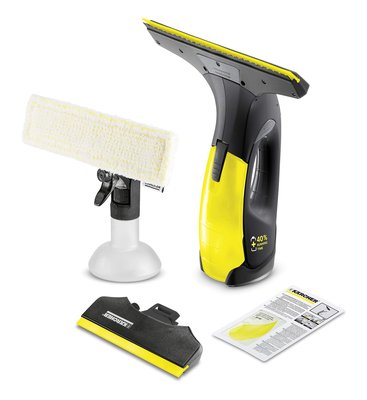
A Karcher window vac is essentially a battery-powered suction tool that sucks dirty water off glass. You spray the window with cleaning solution (usually with the included microfibre pad on a spray bottle handle), scrub the pane, then run the vac head down the glass and it vacuums the water straight into a small tank.
They’ve been around for well over a decade and they’ve got better over the years. Battery life is longer, the heads are better designed, and there are accessories for everything from mirrors to car windscreens.
What a traditional squeegee is
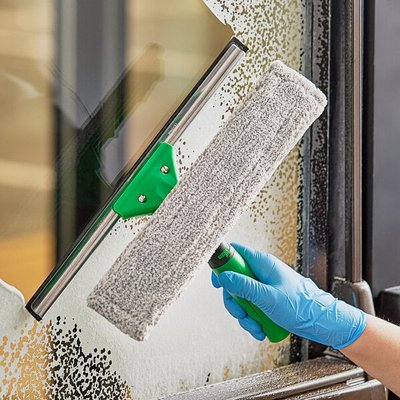
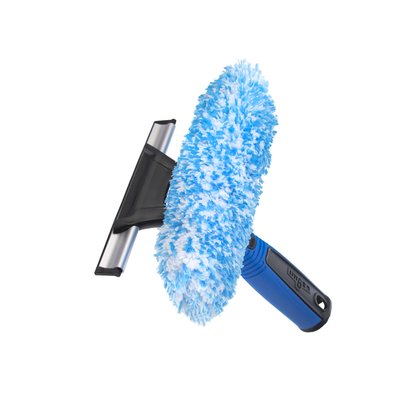
A traditional squeegee is a rubber blade in a metal channel on a handle. You wet the glass with soapy water using a washer, then drag the squeegee across the pane in a controlled pattern to sheet the water off. A quick wipe of the edges with a microfibre or scrim and you’re done.
It’s what professional window cleaners have been using for a hundred years, and it’s still what most of us carry today.
Where the Karcher wins
Small or awkward windows. A Karcher is brilliant on small panes, skylights, glass shower screens and conservatory panels where swinging a squeegee is fiddly. The head is compact, it doesn’t need a full sheet of water to work properly, and you can get into corners easily.
Inside jobs with no mess. This is the big one. For cleaning windows inside the house, a window vac means no drips down the wall, no puddles on the floor, no towels all over the sill. For people with bay windows, sash windows and lots of small panes, that’s a game changer.
Condensation on windows. If you get a lot of winter condensation on your glass, a window vac will clear it in seconds. I’ve got customers who bought one purely for that and never used it for actual cleaning.
Showers and bathrooms. After a shower, a quick run of a window vac over the glass stops all that limescale building up. Much better than a microfibre.
Where the squeegee wins
Large flat glass. On shop fronts, big patio doors and full-length panels, a proper squeegee is still miles faster and gives a better finish. One smooth pull across a metre of glass beats twenty short runs with a window vac every time.
Outdoor work in the cold. Window vac batteries lose power fast in the cold. A squeegee doesn’t care if it’s 2 degrees in January.
Windows that are actually dirty. This is where window vacs really struggle. Heavy bird mess, cobweb build-up, spotting from nearby trees — you need to wash the glass properly with a soapy sleeve first. You can do that and then use a vac to clear it, but by that point you’ve used two tools. A squeegee does both jobs in one pass.
Cost and durability. A good squeegee costs £15 to £30 and will last you years. A window vac costs £60 to £120 and the battery will eventually need replacing. Rubber blades are a few pounds and you just swap them when they wear out.
Honest problems with window vacs
A few things customers don’t always realise:
The battery dies at the worst times. You’ll be halfway through the back of the house and the charge indicator starts flashing. You can’t keep going, you have to wait for it to charge.
The water tank fills up. On a big job, you’ll empty the tank two or three times. Fine at home, annoying if you’re at a friend’s place and there’s nowhere to tip it.
The blade streaks over time. Just like a squeegee, the rubber wears down. Replacement blades for window vacs can actually cost more than a full replacement rubber for a professional squeegee.
They don’t love hard water. Minerals from hard water build up on the rubber head. If you’ve got hard water in your area — and Watford is mixed — you’ll want to wipe the blade dry after every use.
Which should you buy?
If you mostly want to clean inside windows, do a quick job on shower screens, or sort out condensation in winter — get the window vac. It’s genuinely the best tool for those jobs.
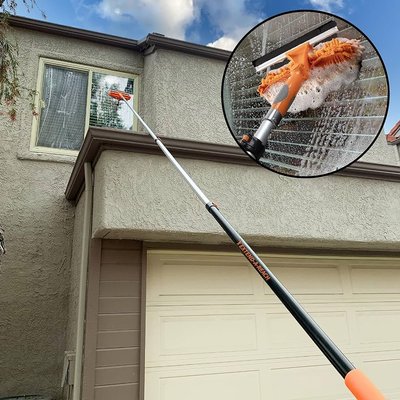
If you want to clean the outside of a whole house, especially if you’ve got big windows or patio doors — get a traditional squeegee, applicator and a telescopic pole. You’ll get a better finish for less money.
If you’re keen, get both. They’re not really competing tools when you think about it — they’re good at different jobs.
What I actually use
For professional work, I rarely pull a window vac out of the van. I’ve got a pure water system for the outside and a squeegee for inside work. Window vacs just aren’t fast enough for full-time cleaning.
At home though? My wife uses our window vac on the shower screens and for a quick wipe of the kitchen windows. It lives in the utility room and it earns its keep.
Both tools have their place. Don’t let anyone tell you one of them makes the other redundant — they don’t.
Need a professional finish?
If you’re in Watford or the surrounding areas and you’d rather leave it to someone who does this for a living, get in touch for a free quote. I use pure water systems, reach and wash, and decades of experience to give your windows a streak-free finish — no matter what tools you’ve tried at home.